
Jump to: State & County Parks | Dark Sky Communities | Observatories & Clubs
Looking to escape the neon glow of the city and view the Milky Way in all its glory? Stargazing near Austin offers some of the best dark sky opportunities in Central Texas. Thanks to the dramatic topography of the Texas Hill Country and local conservation efforts, breathtaking cosmos views are just a short drive away.
Whether you are seeking a peaceful state park night sky, an educational night at a high-powered telescope observatory, or a star party hosted by passionate astronomers, Central Texas has a spot for every stargazing enthusiast.
Editor’s Note: We work hard to provide you with accurate, updated information. However, all details are subject to change. Please verify information before heading out.
This post may contain affiliate links. If you click and make a purchase, we may earn a small commission at no extra cost to you.
We only recommend experiences we truly believe in! Curious about how we choose our content? Here’s our process.
Also check out these articles: Best Hiking Spots in Austin, Best Outdoor Parks and Greenbelts in Austin, Best Hiking Trails & Spots for Hiking in Austin, and Best Horseback Riding in Austin.
Top Parks for Stargazing Near Austin
Enchanted Rock State Natural Area
When you go Enchanted Rock stargazing, expect to see the Milky Way stretch across the sky from the top of a giant granite dome, with nothing blocking your view in any direction.
Enchanted Rock is the closest IDA Gold Tier Dark Sky Park to Austin, and on a clear, moonless night, its Bortle Class 3 skies can sometimes reach Class 2. That means you have a big chance of spotting the Milky Way’s bright galactic core and tracing its structure with your naked eye.
You can join an Austin Astronomical Society star party and look through members’ telescopes, even if you don’t own one yourself. You’re also welcome to bring your own telescope and set it up alongside the club’s equipment.
Prefer to keep things simple? Rangers also offer Stargazing 101 programs in the lower parking lot, where laser guides help you pick out constellations without hiking to the summit.
Plan your visit carefully, though. The front gate closes at 8 p.m., and visits on Fridays, weekends, holidays, and school breaks require a day-use reservation. Sort out your entry before sunset so you don’t end up watching the stars from the wrong side of the gate.
Where: Enchanted Rock State Natural Area, 16710 Ranch Rd 965, Fredericksburg, TX 78624
When: Daily, 6:30 am – 10 pm
How Much: $8 for adults | Free for kids 12 and under
Inks Lake State Park
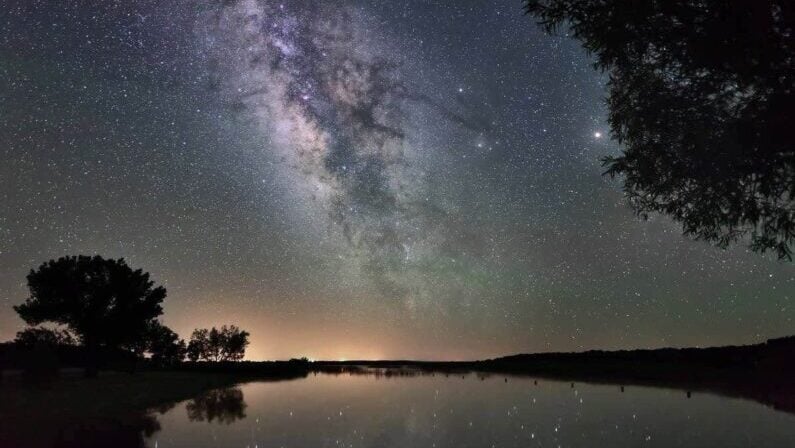
Image credit: Inks Lake State Park – Texas Parks and Wildlife
You don’t need to own a telescope or know the difference between a nebula and a star cluster to join a night of stargazing at Inks Lake.
The Austin Astronomical Society regularly brings its equipment to the dump station across from Central Park, where members set up 6-inch and 8-inch reflector telescopes for visitors to use.
Depending on the night, you might get a closer look at Jupiter, Mars, distant galaxies, or glowing nebulae. Bring your curiosity, and if you have a telescope gathering dust at home, the volunteers can help you figure out how to use it.
The park’s skies typically rate Bortle 4 to 4.5, so you’ll see some light pollution along the horizon, but the Milky Way can still make an appearance on a clear night.
Check the Austin Astronomical Society’s event listings before you visit, and make sure you have a valid park pass. No personal equipment or special astronomy experience is needed to join in.
Where: Inks Lake State Park, 3480 Park Rd 4 W, Burnet, TX 78611
When: Daily, 6 am – 10 pm
How Much: $7 for adults | Free for kids 12 and under
Pedernales Falls State Park
Lie back on warm limestone, listen to the river below, and watch the stars emerge over the Texas Hill Country.
Pedernales Falls offers a different kind of stargazing experience through its ranger-led Hiking to the Stars program. You’ll walk about three-quarters of a mile to the limestone riverbeds, where the group settles onto the flat rock to look up at the night sky.
For a closer look at individual planets, star clusters, and other celestial objects, head to the park’s Star Theater. This dedicated observing area features a level meadow, a limestone amphitheater, and a henge structure, and it serves as the Austin Astronomical Society’s regular field for public star parties.
Members bring multiple telescopes and share views with visitors, giving you a chance to see objects you might never pick out on your own.
The park’s skies generally rate Bortle 4 to 4.5. Austin’s glow affects the eastern horizon, and San Antonio adds light to the south, but the overhead sky and western horizon offer darker views.
Pedernales Falls also hosts roughly 50 night-sky events a year. Reserve your spot at an Austin Astronomical Society star party early. Registration typically opens two weeks before each event, and spaces can fill quickly.
Where: Pedernales Falls State Park, 2585 Park Rd 6026, Johnson City, TX 78636
When: Daily, 8 am – 4:30 pm | Campers with reservations who may arrive after 10 p.m. must call the park before 4:30 p.m. to get the gate code.
How Much: $6 for adults | Free for kids 12 and under
Guadalupe River State Park
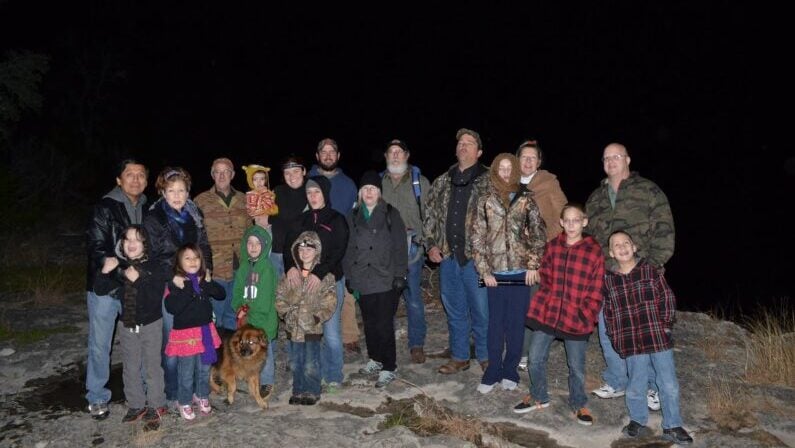
Image credit: Guadalupe River State Park – Texas Parks and Wildlife
Follow the blue Stargazing Tonight sign, and you’ll find your way to an evening of telescope viewing at Guadalupe River State Park.
On scheduled nights, members of the San Antonio Astronomical Association set up several telescopes in the overflow parking lot for public star parties, usually running from 8 to 10 p.m.
You can move between stations as volunteers point out the night’s highlights, which may include planets, the moon, star clusters, nebulae, and bright galaxies. Just show up, take a look, and ask questions as you go.
The park’s Bortle 4.5 skies aren’t completely free of light pollution, but its location helps. San Antonio’s glow sits to the south, while Austin’s appears to the northeast, leaving the overhead sky and northern horizon in better shape for stargazing.
On a clear night, you may even spot the Milky Way’s structure stretching overhead.
Public star parties are typically drop-in events, so you won’t necessarily need to plan weeks ahead or bring any equipment of your own. Still, check the Texas Parks and Wildlife Department’s calendar before setting out.
Where: Guadalupe River State Park, 3350 Park Rd 31, Spring Branch, TX 78070
When: Daily, 8 am – 4:30 pm
How Much: $7 for adults | Free for kids 12 and under
Pace Bend Park
You can get a change of scenery and a darker view of the sky without spending half the night driving out of Austin. About 45 minutes from the city, Pace Bend Park sits on a limestone peninsula jutting into Lake Travis.
Head toward the western cliffs, where open water replaces much of the development you’d otherwise see on the horizon. With Austin’s light dome behind you, the position gives you a better shot at enjoying the stars than you might expect this close to town.
Pace Bend has hosted public stargazing programs through the Travis County Parks Foundation, including its Night Sky Explorer events, as well as star parties in partnership with the Austin Astronomical Society and Reimers Observatory.
These programs give you a chance to explore the night sky with guidance rather than simply hoping you recognize a constellation or two. Events aren’t necessarily held every month, though, so check the foundation’s calendar before planning your visit.
You can also bring your own telescope or settle in for self-guided stargazing when conditions are right. Just remember that day-use access ends at dark, so you’ll need a camping permit for a late-night visit.
Bring cash for the entrance fee, too, as the park only accepts cash at the gate.
Where: Pace Bend Park, 2805 Pace Bend Rd N, Spicewood, TX 78669
When: Daily, Sunrise to sunset
How Much: $5 for adults | $3 for seniors | Free for kids 12 and under | Starts at $15 for camping
Designated Dark Sky Communities Near Austin
Dripping Springs Dark Sky District
Dripping Springs stargazing gives you a dark sky without you having to venture deep into the Hill Country, thanks to a community lighting ordinance that’s been in effect since 2000.
The town became an International Dark Sky Community in 2014. And the rules extend beyond the city limits, too, helping protect a wider stretch of the Hill Country dark sky from excessive light pollution.
Even gas stations use shielded lights directed toward the ground, so you’re not dealing with the same glare you’d find in more developed areas.
For a full evening of astronomy and local entertainment, put the annual Texas Night Sky Festival at Dripping Springs Ranch Park on your calendar. You can check out solar observations, explore multiple planetariums, browse exhibits showcasing Texas dark sky destinations, and hear talks from speakers before the star party begins after dark.
The city also hosts a separate Star Party at the ranch during Hill Country Night Sky Month in October.
Prefer to explore at your own pace? Dripping Springs’ parks stay open until midnight, giving you room to settle in for a quieter night under the stars.
The area also puts you within easy driving distance of Reimers Observatory and Pedernales Falls State Park, where you can find additional astronomy programs.
Where: Dripping Springs, TX
When: Daily, Open 24/7
How Much: Varies
Wimberley Valley Dark Sky Community
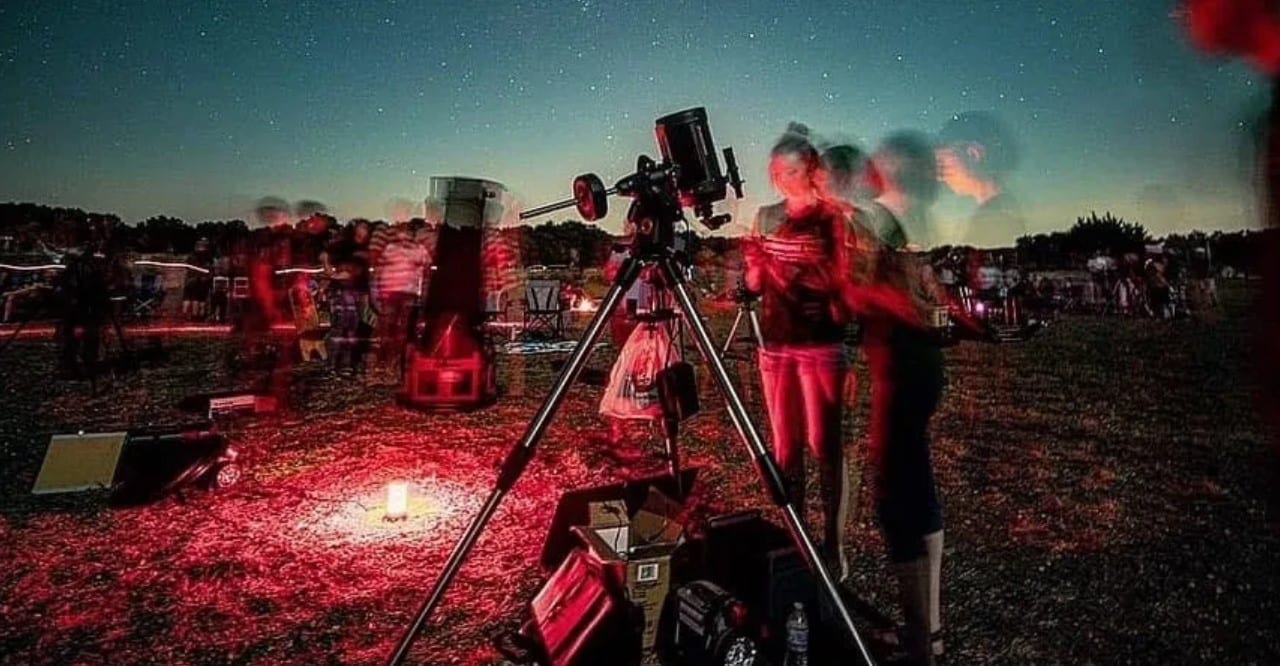
Image credit: Wimberley Parks and Rec
Imagine driving through the Hill Country at night and spotting the Milky Way without even having to pull over. That’s one of the things that makes Wimberley Valley special. Its relatively dark skies remain visible as you travel through the area, rather than disappearing beneath the glare of bright roadside businesses.
The community earned its International Dark Sky designation in 2018, and DarkSky International named it the Dark Sky Place of the Year in recognition of its achievements in protecting the night sky.
For a closer look, head to Blue Hole Regional Park for the Blue Hole Star Party, held twice a year in spring and fall.
The evening starts with live music, giving you time to settle in before the Astronomy Club at Texas State University sets up its telescopes on the soccer fields after dark.
Club members help you explore celestial sights such as planets, star clusters, and the Orion Nebula, explaining what you’re seeing as you move between telescopes. A laser-guided tour of the night sky wraps up the experience, helping you pick out constellations and other features overhead.
If you’ve got a telescope at home but haven’t quite mastered the setup, Wimberley Valley Dark Sky also offers a free Telescope Teaching Seminar at Blue Hole Regional Park before the spring star party. It’s a useful chance to get comfortable with your equipment before taking it out for a night of stargazing.
Where: Wimberley Valley, TX
When: Daily, Open 24/7
How Much: Varies
Observatories & Local Astronomy Clubs
Reimers Observatory at Milton Reimers Ranch Park
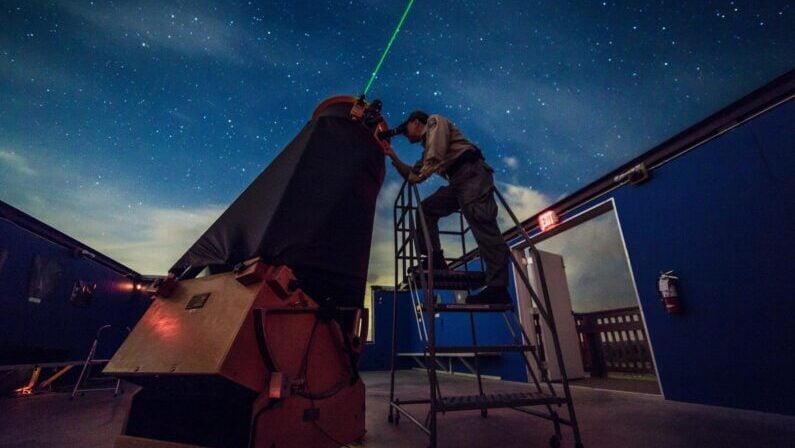
Image credit: Travis County TX
Take a look through a 25-inch telescope at Reimers Observatory, and planets and distant galaxies start revealing details you’d never pick out with your naked eye.
The observatory sits inside Milton Reimers Ranch Park, an IDA-designated Dark Sky Park, where the relatively dark Hill Country skies allow the stars and cosmos to glow above you..
Its main instrument is a massive 25-inch Obsession Dobsonian, with a 15-inch telescope helping accommodate visitors. On a good night, you could see Jupiter’s cloud bands and moons, Saturn’s rings with the Cassini Division visible as a distinct gap, or deep-sky objects that appear as little more than smudges through smaller telescopes.
Staff guide you through the telescopes and use laser pointers to identify constellations, features of the Milky Way, and even satellites moving across the sky in real time. You’ll also hear how light pollution from Austin and San Antonio affects the views.
Programs typically last two hours, and around 100 sessions are offered each year. Reservations appear on the Travis County Parks website two to four weeks ahead, and popular dates can fill quickly.
You can also arrange a private two-hour group session for up to 30 people for $200. Bring cash for the park entrance fee if possible, as it’s preferred at the gate.
Where: Milton Reimers Ranch Park, 23610 Hamilton Pool Rd, Dripping Springs, TX 78620
When: Varies
How Much: $10 per adult | $8 per senior (62+) | Free for kids 12 and under
Austin Astronomical Society Star Parties
You could spend an evening moving between telescopes, seeing what each one reveals about the night sky, and chatting with the people who brought them at Austin Astronomical Society Star Parties.
Club members bring their personal equipment and invite visitors to take a look, so you might spot a sparkling open star cluster through one telescope before stepping over to another for a closer view of Saturn’s rings.
The society also maintains its own collection of 6-inch and 8-inch reflector telescopes, giving you plenty to explore even if fewer members bring their own gear.
The society holds public events at places such as Inks Lake and Pedernales Falls State Park, with occasional gatherings at Enchanted Rock. Its annual Austin Under the Stars event brings the experience closer to the city, with 15 to 25 telescopes set up on the football field at St. Stephen’s Episcopal School.
Got a telescope sitting at home that you’ve never quite figured out? Bring it along. The society encourages beginners to get help with their equipment, and its additional resources include a loaner telescope program and telescope clinics at its Area512 storage facility.
For upcoming public star parties around the Hill Country, check the schedule at austinastro.org before planning your trip.
Where: Varies
When: Varies
How Much: Free
Eagle Eye Observatory at Canyon of the Eagles
Spend an evening on a hilltop above Lake Buchanan, looking through powerful telescopes as the Hill Country sky darkens overhead.
About 90 minutes from Austin, Eagle Eye Observatory benefits from Bortle 3 skies on clear, moonless nights.
Astronomer Jim Sheets, who has more than 65 years of experience, leads the observatory’s The Stars at Night program. At dusk, he opens the sliding roof, introduces the objects visible that evening, and guides you through views using two Newtonian reflecting telescopes.
You might examine craters on the moon, pick out details on a planet, or peer at distant galaxies, nebulae, and star clusters. Sheets runs the sessions himself and welcomes questions throughout, so you can learn as much as you like while taking turns at the eyepiece.
The program runs multiple times a week, with the 2026 summer schedule offering sessions on most days.
You can also bring your own telescope and stargaze around the observatory grounds independently of the scheduled sessions. Tent and RV campsites are available at the park, too, making an overnight stay a sensible choice if you’d rather keep exploring the sky than drive back to Austin after dark.
One detail to keep in mind when planning your visit: Canyon of the Eagles manages the observatory’s programs directly, so check the resort’s own schedule and booking page for available dates rather than looking for an Austin Astronomical Society event.
Where: Eagle Eye Observatory, Burnet, TX 78611
When: Varies
How Much: $25 per adult | $15 for ages 5-12 | Free for 4 and under
Know Before You Go: Stargazing in Greater Austin & the Hill Country
Austin’s city lights make it difficult to see fainter stars and deep-sky objects, but you don’t have to drive far to find darker skies. Depending on where you’re headed, you can reach good stargazing spots in about 30 to 75 minutes.
Dripping Springs, Bee Cave, Lakeway, and Spicewood are useful starting points for exploring the Texas Hill Country, where parks and protected dark-sky areas offer better views of the night sky.
A little planning also goes a long way.
Check the moon phase before you leave. Nights around the New Moon are usually best for spotting faint stars and the Milky Way.
Check the forecast for clouds, too, and bring a flashlight with a red-light setting to help preserve your night vision. Pack an extra layer, even in summer, since sitting outside after dark can get chilly.
Frequently Asked Questions About Stargazing Near Austin
When is the best time to see the Milky Way near Austin?
In Central Texas, the Milky Way’s bright central region is generally visible on clear nights from late spring through early autumn, roughly May to October.
Plan your outing around the New Moon, when there’s less moonlight to wash out the fainter details. You’ll also need clear skies and a spot away from bright lights for the best view.
Do I need to make reservations for stargazing at state parks?
It depends on the park and how you plan to visit. Popular destinations such as Enchanted Rock and Pedernales Falls can reach capacity, so check the Texas Parks and Wildlife Department website before leaving home.
Some visits require a day-use reservation, while overnight stays and certain guided programs have their own booking requirements. Check the rules for your specific destination, especially if you’re planning a weekend trip.
What equipment should I bring for casual stargazing?
You can enjoy stargazing near Austin without buying a telescope. A pair of 10×50 binoculars can help you spot star clusters and other details, while a star map or an astronomy app such as Stellarium can help you identify constellations and planets.
Bring a reclining camp chair or blanket, a red-light flashlight, water, and a layer for when the temperature drops. If you’re attending a public star party, you may also get to look through astronomers’ telescopes without bringing any equipment of your own.
Looking for more fun in the city? See the upcoming Weekend Events in Austin.

- Best Stargazing Spots Near Austin in the Texas Hill Country - October 15, 2026
- Things to do in Austin this Weekend | October 16 – October 18 - October 12, 2026
- Austin Highlights: October 12 to October 15 – Food, Music, Arts & More - October 11, 2026
Leave a Reply
You must be logged in to post a comment.